
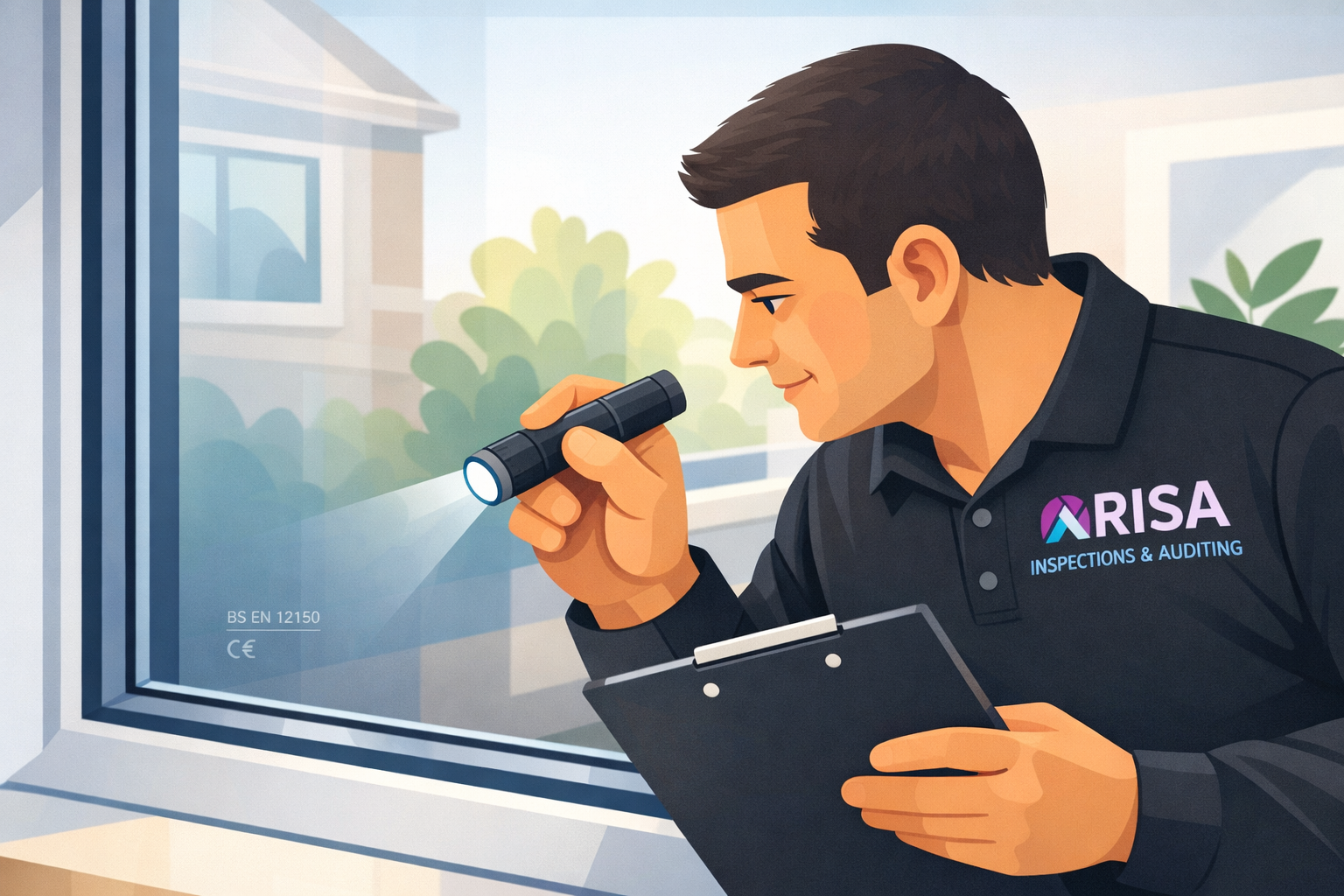
Glass Markings Explained: Why Are There Stamps on My Windows?
If you’ve noticed a small stamp in the corner of your window or door glass, you’re not alone.
Many homeowners ask:
- Why is there a marking on my glass?
- Is it compulsory?
- Can it be removed?
- Why don’t all the panes match?
- Why is it only on some windows?
This guide explains what glass markings mean, when they are required, and why they are actually there for your protection.
What Is a Glass Marking?
A glass marking is a permanent stamp applied during manufacture to confirm that the pane meets recognised safety standards.
It is not a sticker. It is usually:
- Laser marked
- Sandblasted
- Screen printed
The marking confirms that the glass complies with impact safety standards such as BS EN 12600, which governs safety glass performance .
In simple terms:
The mark proves the glass has been tested and meets safety requirements.
What Type of Glass Has a Permanent Mark?
Only safety glass carries a permanent marking.
The two most common types in homes are:
Toughened (Tempered) Glass
Heat-treated so that if it breaks, it shatters into small blunt fragments.
Laminated Safety Glass
Contains a plastic interlayer that holds the glass together if it cracks.
Both types must be marked when installed in certain locations defined by Building Regulations .
Ordinary float glass does not carry a safety mark.
Why Is Safety Glass Required in Certain Areas?
Building Regulations require safety glass in what are known as “critical locations.”
In domestic properties, this generally includes:
- Glass in doors
- Glass within 300mm of a door edge
- Glass below 800mm from floor level
These are areas where people are most likely to walk into or fall against glass.
Where safety glass is required, it must also be permanently and visibly marked after installation .
That is why you may see markings on some panes but not others.
Does the Glass Have to Be Marked?
In critical locations, yes.
Building standards require that installed safety glass is indelibly marked and visible after installation .
If there is no visible marking in a location where safety glass is required, the assumption is that it is not compliant .
Even if the glass looks toughened or laminated, without a visible mark it cannot be formally confirmed as compliant.
Why Are the Marks in Different Corners?
Homeowners often notice that:
- The inner pane mark is in one corner
- The outer pane mark is somewhere else
- They don’t line up neatly
This is normal.
In a double or triple glazed unit:
- The inner and outer panes may be different glass types
- They are often manufactured separately
- One pane may be coated or handed differently
Because of this, it is not always possible to align the markings in the same corner .
Industry practice is usually to position the mark approximately 25mm from a corner so it remains visible after glazing .
“The Marking Looks Obtrusive – Can It Be Removed?”
This is one of the most common concerns.
Some homeowners feel the stamp is unsightly. However:
- It is usually required by Building Regulations.
- It must remain visible to demonstrate compliance.
- It cannot simply be polished off without damaging the glass.
Removing or obscuring the marking may invalidate compliance.
In most cases, the mark is small and discreet. Over time, many homeowners no longer notice it.
Can the Markings Be Positioned More Consistently?
While it may not always be possible to perfectly align markings on multi-pane units, you can:
✔ Discuss this with your installer before installation
✔ Ask which panes will require safety markings
✔ Request that markings are positioned as consistently as manufacturing allows
Early communication is key. Once the units are manufactured, repositioning the marks is not possible.
What If I Can’t See Any Marking?
Sometimes the marking is:
- Very faint
- Hidden behind glazing beads
- On the outer pane
- Obscured by coatings or textured finishes
In many inspection cases, markings are present but overlooked initially .
If no marking can be found in a critical location, it should be investigated.
Why Glass Markings Matter for Homeowners
Glass markings:
- Confirm compliance with Building Regulations
- Provide evidence of safety performance
- Demonstrate that the correct product has been installed
Under current guidance, safety glass in critical locations must be marked and visible after installation.
The small stamp in the corner is not a defect — it is proof that your glazing meets required safety standards.
Final Thoughts
While glass markings may not always look perfectly aligned, they exist for an important reason: to confirm your home is fitted with the right glazing in the right place.
If you are planning new windows or doors and are concerned about the appearance of safety markings:
- Raise it with your installer at quotation stage
- Ask where safety glass will be required
- Discuss positioning before manufacture
A professional installer will be able to explain what is required and what can reasonably be achieved.
If you are in any doubt as to whether the correct safety glass has been installed in your property, RISA can assist with an independent inspection and provide formal confirmation. Our highly trained inspectors utilise specialist inspection equipment and calibrated testing instruments to accurately assess glazing type, compliance and installation standards.