
Definitive results for draught disputes
Quantifying Air Infiltration in Windows and Doors: Moving from Opinion to Measurable Evidence
Air leakage and draughts remain one of the most common and persistent concerns raised by homeowners in relation to windows and doors. Complaints of discomfort, heat loss, and perceived poor product performance are frequently encountered, and in many cases, they can lead to dispute.
At RISA, we have extensive experience in identifying air infiltration through detailed on-site inspection. Using established diagnostic techniques, we can typically pinpoint areas of weakness—whether relating to installation defects, sealing failures, or product limitations. However, while qualitative assessment is valuable, it does not always satisfy the need for certainty.
Increasingly, clients—whether homeowners, contractors, or manufacturers—are seeking a definitive, quantifiable measure of air leakage.
The Challenge of Measurement
Air infiltration is not always straightforward to quantify in real-world conditions. Unlike controlled laboratory environments, installed windows and doors are subject to a wide range of variables, including:
- Installation quality
- Interface detailing with surrounding construction
- Building movement and settlement
- Environmental exposure
While all windows and doors sold within the UK should be tested and classified for air permeability under BS 6375, these results are derived under controlled test conditions. The challenge has always been:
How do we verify that installed products are performing to their accredited standard in situ?
A New Approach: Pulse Air Pressure Testing
RISA has developed a scientifically grounded methodology to address this exact issue.
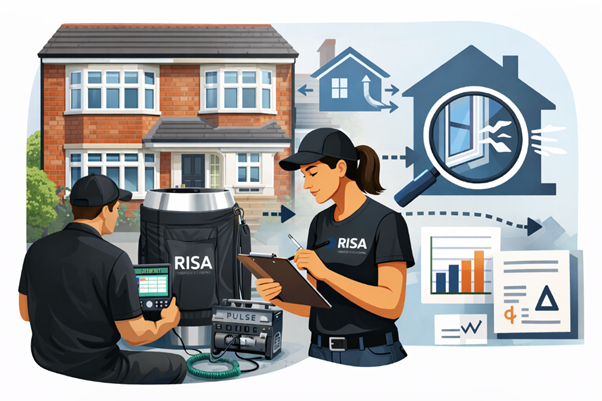
Using advanced pulse air pressure testing equipment, we are now able to measure and isolate the contribution of windows and doors to overall building air leakage. This represents a significant step forward in diagnostic capability within the fenestration sector.
The process involves:
- Baseline Measurement
The property is initially pulse tested to establish its overall air permeability characteristics. - Isolation of Fenestration Elements
Windows and doors are then carefully isolated using specialist taping and sheeting methods, ensuring they are effectively excluded from the test envelope. - Repeat Testing
A second pulse test is conducted under identical conditions. - Comparative Analysis
Using a specifically developed mathematical model, the difference between the two datasets is analysed to quantify the air leakage attributable to the windows and doors.
From Assumption to Evidence
This methodology allows us to move beyond subjective assessment and into evidence-based evaluation. Crucially, it enables us to determine whether installed windows and doors are performing in line with their accredited air permeability ratings.
This is particularly valuable in situations where:
- There is a dispute regarding product performance
- Responsibility between manufacture and installation is unclear
- Clients require objective verification rather than opinion
- Traditional inspection methods are inconclusive
A Step Forward for the Industry
The ability to quantify air infiltration at this level is a relatively new development within the industry. Historically, many cases involving draught complaints have relied heavily on interpretation and professional judgement.
By introducing measurable data into the process, RISA can now provide:
- Greater clarity in dispute resolution
- Increased confidence for all parties involved
- A more robust technical basis for conclusions
When Is This Type of Assessment Appropriate?
Pulse air pressure testing is particularly beneficial where:
- Air leakage is significant but difficult to localise
- There is disagreement over whether performance meets specification
- A formal, defensible assessment is required
Further Information
If you would like to understand more about how this assessment works, its limitations, or whether it is appropriate for your situation, we welcome you to get in touch.